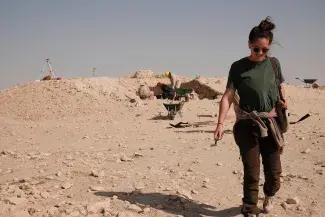
Researcher Profile: Marie Laguardia
A young researcher on a postdoctoral contract for the Jaussen & Savignac programme, Marie Laguardia has chosen funerary archaeology as her field of study: Researcher Profile.
A young researcher on a postdoctoral contract for the Jaussen & Savignac programme, Marie Laguardia has chosen funerary archaeology as her field of study. It is a specialism that is not always understood and sometimes even feared, as it confronts us head-on with our own mortality.
As a child, she was fascinated by archaeology, but when it came time to make a choice, Marie opted for a degree in Biomedical Sciences at Paris-Descartes University (now Paris Cité since 2019). This course allowed her to acquire knowledge in life sciences, including biochemistry, human biology (physiology, genetics, neurobiology, immunology, etc.), chemistry, physics and cognitive neuroscience, setting her on a path towards a career in laboratory work.
Then, during this training, she realised that what interested her was understanding human beings in all their dimensions, and so she turned her attention to the humanities. « I needed more depth », she explains, « and it seemed essential to me to also address the historical dimension of individuals. So I decided to switch to a Bachelor's degree in Art History and Archaeology at Paris 1 Panthéon-Sorbonne, where I entered directly into the third year, with a major in archaeology ».
From the beginning, Marie Laguardia developed a passion for ancient history and the Roman world, particularly in the Near East. Ultimately, this attraction to funerary archaeology and biological anthropology – that is, everything related to bones and human skeletal remains that can be used to determine age, sex, possible pathologies, etc. – manifested itself very quickly: There she found a way to combine her knowledge of biomedical sciences and history, thereby restoring a human dimension to skeletal remains and bringing the stories of long-forgotten lives back to life. To further develop this emerging career path, Marie Laguardia is studying biological anthropology alongside archaeology, thanks to courses offered by Paris 1 Panthéon-Sorbonne University and internships with the University of Bordeaux (PACEA laboratory, From Prehistory to the Present: Culture, Environment and Anthropology UMR 5199) and the National Museum of Natural History in Paris.
Jaussen & Savignac Programme – Then you are confronted with the reality on the field?
Marie Laguardia – Yes, in 2016, during my first year of my Master's degree in Archaeology, I had the opportunity to go into the field with the Franco-Lebanese archaeological mission in Ej-Jaouzé (Metn, Lebanon), co-directed by Lina Nacouzi (Institut français du Proche-Orient - Ifpo) and Dominique Pieri (University of Paris 1 Panthéon-Sorbonne) (mission supported by the Ifpo and the MEAE excavation commission). That year, the excavations revealed the existence of an untouched tomb: Dominique Pieri and Lina Nacouzi placed their trust in me and entrusted me with the study of this tomb. This was my first experience of excavating a collective tomb and studying human skeletal remains. It was this discovery that formed the subject of my Master's thesis, supervised by François Villeneuve: « Funeral practices in the Lebanese mountains based on the example of the collective tomb of Ej-Jaouzé ».
During my second year of my Master's degree, François Villeneuve told me about the archaeological mission in Thāj (Saudi Arabia) co-directed by Jérôme Rohmer (CNRS) and Ibrahim al-Mshabi (Saudi Commission for Tourism and National Heritage). They were looking for someone to study the necropolis of this huge caravan city, which has a burial ground with over 1,000 burial mounds. I wanted to continue with a PhD, and studying the Thāj necropolis was exactly what I specialised in, covering the period and geographical area I was interested in. After meeting Jérôme Rohmer, my project took shape and I obtained a doctoral contract at Paris 1 Panthéon-Sorbonne with the thesis topic ‘Funeral practices in north-eastern Arabia: the necropolis of Thaj from the Iron Age to late antiquity’. I defended my thesis in 2022 and last year I secured a postdoctoral contract with the Jaussen & Savignac programme to continue developing my research in the region.
PJ&S – Could you explain to us what funerary archaeology is all about ?
M. L. – Funeral archaeology allows us to understand the living by studying the dead. We analyse the skeletal remains of ancient populations, of course, but also burial practices: the architecture of tombs, the position of bodies, the grave goods placed near the deceased, and all the symbolism associated with them. All of this helps us to understand the ideology of these populations and to define the different social statuses that made up these ancient societies, as well as all the cultural influences through trade, etc. What makes the Thāj necropolis so interesting is its size: the corpus is vast and allows us to refine our understanding of the lives of the populations of Arabia and how they perceived death. From a biological point of view, the study of bones allows us to characterise the profile of individuals and question their relationships: are there differences between men and women, between adults and children? In Thāj, tombs have been excavated where foetuses (babies who died in childbirth) have been found alongside adult burials. This leads us to believe that, in this society, at a certain period in time, all age groups had access to burial, which was not necessarily the case in other regions of the ancient world.
Anthropological studies also shed light on diet, with markers of activity on bones revealing signs such as wear and tear, fractures, etc., which can provide clues about occupations, for example. In this part of the world, we are still in the early stages of discovering what we can learn about these populations during Antiquity.
PJ&S – What do you say to those who are uncomfortable with funerary archaeology and the idea that someone might come and disturb bones in order to study them?
M. L. – For me, funerary archaeology is a way of paying tribute to these people who have been forgotten for centuries and are now being rediscovered: we are giving them back their voice and they are teaching us a great deal. What's more, we handle these human bones with great care, respect and gratitude for what they reveal to us. So studying these graves is also a way of protecting them and preventing them from being destroyed and disappearing forever, especially as graves have been subject to much looting and destruction over the centuries (particularly with the spread of urbanisation).
PJ&S – If you look back on your career, what were the ingredients of your success?
M. L. – I have been very lucky. Everything fell into place very well, and I felt encouraged by the trust that was placed in me, both by François Villeneuve for my thesis and by Jérôme Rohmer for the study of the Thāj necropolis, which were major experiences for me. During my thesis, I was supervised by researchers who taught me a great deal. I would particularly like to mention Olivia Munoz (CNRS), with whom I participated in prospecting and excavation missions in Oman, Patrice Courtaud (CNRS), who trained me in paleopathology, and Lidewijde De Jong, co-director of my thesis (University of Groningen), who encouraged me to develop the methodological aspects of my research. In order to study the Thāj necropolis as a whole, I chose to take a multidisciplinary approach to deal with a wide variety of data: from the spatial analysis of the tombs using GIS, to their architectural study, to the human remains discovered in the burials. This multi-scale analysis allowed me to develop a variety of skills, which I am now able to apply to other projects.
PJ&S – Today you are a young doctor and you are heading into the field as co-director of the second Franco-Saudi archaeological campaign in Thāj?
M. L. – Right after my thesis viva, I had the opportunity to set up a new Franco-Saudi research programme following Jérôme Rohmer's mission, under the auspices of the Heritage Commission and the CNRS (UMR 7041 ArScAn-OrAM) to continue studying this necropolis over the next four years (supported by the MEAE excavation commission). In fact, two women co-directed the first campaign: Norah Al-Qahtani (from the Saudi Heritage Commission) and myself.
With over 1,000 years of occupation, the earliest traces of which date back to the 8th century BCE, this necropolis deserves further time and research to enable it to reveal more detailed information about its chronology and the succession of funerary practices over the centuries. This fieldwork is part of my research project on the dynamics of settlement on the Arabian Peninsula based on the socio-cultural and biological study of populations.
PJ&S – What advice would you give to students who want to pursue this specialisation in funerary archaeology?
M. L. – I would say that you shouldn't hesitate to get training: just because you're studying archaeology doesn't mean you shouldn't explore other related disciplines that touch on the human condition. By diversifying, you often come up with good ideas and new methods that you can apply to your research. It also allows you to meet people who can turn into opportunities. The second piece of advice I can give is to get out into the field: that's where you learn a lot, and not just technical skills. You meet lots of specialists, which gives you experience of multidisciplinary and collaborative research. It's not by working alone that you understand a site, but by working with others: in this respect, archaeology is a true exercise in collective intelligence.
Further reading:
Research areas and bibliography