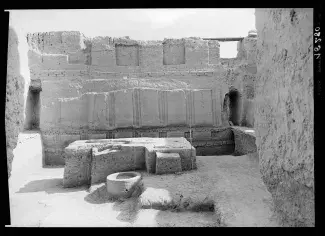
Proceedings of the postdoctoral seminar ‘Archaeological archives of the Ancient Near East: analytical approaches and new perspectives’
The Jaussen & Savignac program's postdoctoral seminar ‘Archaeological Archives of the Ancient Near East: Analytical Approaches and New Perspectives’, organised by Dr Hugo Naccaro, was held at the Université Paris 1 Panthéon-Sorbonne between January 28 and March 18, 2026. Consisting of seven sessions, it shed new light on the archaeological archives of several major sites in the ancient Near East.
Following an introduction that established the epistemological foundations for the study of this specific type of material (Hugo Naccaro), the case study devoted to Khorsabad (Iraq) (Barbara Couturaux and Jean-Jacques Herr) highlighted the importance of working with archival documentation in a context with new fieldwork programs. The systematic work carried out on the archives from the earliest excavations at Khorsabad, dating back to the 19th century, resonates with research conducted on the archaeological archives of Susa (Iran) (Clélia Paladre). These archives reflect excavation techniques and methods of data recording that differ radically from those used today. Their study makes it possible to uncover new information and to bring renewed attention to long-neglected results. The scientific importance of archaeological archives, whose practices have evolved significantly over the long term, was also demonstrated through research conducted at the site of Mari (Syria) (Pascal Butterlin), representing nearly 90 years of investigation and multiple cycles of research devoted to this former Mesopotamian capital. Then, the issue of publishing these archives and the methodologies employed was addressed through case studies at Lagash (Iraq) (Steve Renette) and Tureng Tepe (Iran) (Camille Abric & Julie Bessenay-Prolonge). These works show that refined analytical methodologies can yield significant results and emphasize the necessity of publishing long-unexplored archival collections. Finally, from an interdisciplinary perspective, and in light of the scientific and heritage challenges posed by these archives, the integration of new methods of processing and analysis, particularly the use of artificial intelligence, opens up considerable new perspectives (Hugo Naccaro & Thomas Gerald).
The seminar thus provided an overview of the major research issues related to archaeological archives, of great importance to the archaeological and heritage communities. It brought together a diverse audience of students, researchers, academics, and engineers. Its success, along with the many questions it raised, highlights the value of repeating this seminar in the future.