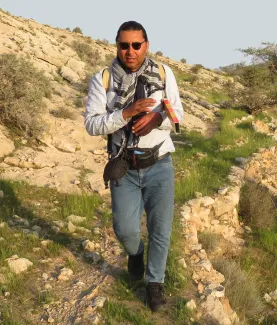
Parsa Ghasemi: Rethinking the Sasanian Presence in the Arabian Peninsula
A postdoctoral researcher funded by the Jaussen & Savignac Programme in 2025–2026, Parsa Ghasemi focuses his research on the presence, influence and interactions of the Sasanians (AD 224–651) in the eastern and southern regions of the Arabian Peninsula.
His project has explored the nature and extent of Sasanian activities in the region by bringing historical and archaeological sources into dialogue and re-examining both older and more recent data. His fellowship also enabled him to develop new scientific collaborations and deepen his understanding of the Arabian Peninsula’s diverse historical and environmental contexts.
What were the main focuses of your research during your postdoctoral fellowship at the Jaussen & Savignac Programme?
Parsa Ghasemi: During my postdoctoral fellowship, I focused my research on the nature and extent of Sasanian activities in the Arabian Peninsula. My project brought historical and archaeological sources into dialogue and involved re-examining a body of data that had not always been studied systematically.
Over the course of eighteen months, I conducted extensive research and reviewed both earlier scholarship and more recent studies on the history and archaeology of the region. This work also led me to revisit previously compiled data, including publications, preliminary reports, archival material and other sources that had received limited attention until then.
This reassessment opened up new perspectives for studying the political, military, economic and cultural dimensions of Sasanian involvement in the Arabian Peninsula.
How did changes in the research context influence your project?
Parsa Ghasemi: The instability affecting certain parts of the Middle East over the past several months prevented me from undertaking the fieldwork initially planned. These circumstances led me to devote greater attention to studying existing data and placing it within a broader regional framework.
This work enabled me to deepen my knowledge of the Arabian Peninsula’s different regions, their varied climatic and environmental zones, and their histories. It also allowed me to become more familiar with the substantial body of recent archaeological research devoted to the region.
The project therefore considerably broadened my understanding of the history of the Arabian Peninsula in Antiquity and the early medieval period, while allowing me to further develop my approach to the archaeology of the region and the diversity of its historical and environmental contexts.
You also organised an international conference at the Jaussen & Savignac Centre. What was its purpose?
Parsa Ghasemi: One of the main outcomes of my postdoctoral fellowship was the organisation of an international conference at the Jaussen & Savignac Centre on 28–29 May 2026, devoted to the Parthian and Sasanian worlds and the different regions of the Arabian Peninsula.
The conference brought together specialists working on several regions of the peninsula, as well as on the Parthian and Sasanian worlds. It encouraged dialogue between different research approaches and perspectives.
The conference proceedings are currently being prepared for publication in the coming months. Several articles arising from the research conducted during my postdoctoral fellowship are also in preparation and will examine certain aspects of this work in greater detail. Further results from the project will be published over the coming years.
How did your postdoctoral fellowship contribute to the development of scientific collaborations?
Parsa Ghasemi: My Jaussen & Savignac fellowship enabled me to develop an international network of researchers working on the Arabian Peninsula and expand my scientific collaborations.
This experience helped me deepen my understanding of the peninsula’s diverse environmental and historical contexts, as well as the interactions between its different regions and neighbouring worlds.
Your time at Université Paris 1 Panthéon-Sorbonne is part of a longer academic journey. How has this experience developed?
Parsa Ghasemi: I joined Université Paris 1 Panthéon-Sorbonne in 2015 for my doctoral studies and became a member of the Archéologies et Sciences de l’Antiquité (ArScAn) research unit, within the L’Orient, d’Alexandre à Muhammad. Archéologie-Histoire-Architecture-Épigraphie (OrAM) team, based at the Maison des Sciences humaines et sociales Mondes. My academic journey subsequently continued with my postdoctoral fellowship at the Jaussen & Savignac Programme.
Over the years, Université Paris 1 Panthéon-Sorbonne, the Jaussen & Savignac Centre and the ArScAn research unit have provided an essential framework for the development and advancement of my research. This experience has also given me the opportunity to work alongside professors, researchers, colleagues and friends, fostering scientific exchanges, collaborations and lasting relationships.
I would like to express my profound gratitude to the Centre’s director, Professor Gaëlle Tallet, as well as to the members of the recruitment committee and the administrative team, for their support and for helping to create an intellectually stimulating and institutionally supportive environment for the development of my research.
What are the next steps in your research following your time at the Programme?
Parsa Ghasemi: Following my postdoctoral fellowship at the Jaussen & Savignac Programme, I will continue my research through a new postdoctoral project funded by a Marie Skłodowska-Curie Fellowship.
This project will focus on Sasanian investments in their region of origin, comparing them with those undertaken in other regions of the Sasanian Empire. This comparative approach will make it possible to examine the different forms and rationales of investment across the empire.
Drawing on the knowledge of the Arabian Peninsula that I acquired during my Jaussen & Savignac fellowship, I will also be able to incorporate this region into the comparison.
My time at the Programme has therefore enabled me to deepen my knowledge of the Arabian Peninsula and develop expertise that I can directly apply to my future research on the Sasanian Empire.
About Parsa Ghasemi’s doctoral thesis
My doctoral thesis, entitled *The Archaeological Landscape of the Sar Mashad Region, Southwestern Fars, Iran: Settlement and Land Use in the Sasanian and Islamic Periods*, was undertaken at Université Paris 1 Panthéon-Sorbonne (Doctoral School of Archaeology 112), within the ArScAn research unit and its OrAM team, under the supervision of Michel Mouton. I defended my thesis in June 2022, and it received no dedicated funding.
This research drew on the acquisition and analysis of new archaeological field data from the historical heartland of the Sasanian Empire, in the province of Fars. It contributed to a deeper understanding of Sasanian investment, settlement and territorial development in semi-arid environments. In particular, it enabled the identification and documentation of numerous archaeological sites and several features of the ancient landscape, providing new evidence for the study of territorial organisation, settlement dynamics and resource exploitation. More broadly, it contributed to renewing our understanding of one of the great empires of Late Antiquity in the eastern world.