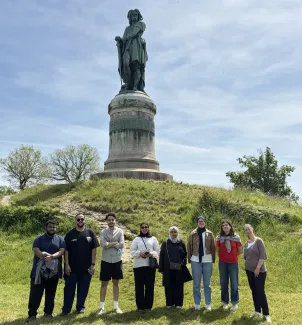
Jaussen & Savignac Master’s Students Undertake Preventive Conservation Training at Alésia
As part of the Master’s Year 1 programme in Archaeology and Preventive Conservation within the Jaussen & Savignac Programme, delivered by Université Paris 1 Panthéon-Sorbonne in partnership with The Royal Commission for AlUla, students took part, from 18 to 21 May 2026, in a training placement dedicated to preventive conservation and the management of archaeological collections in Alise-Sainte-Reine, at the historic site of Alésia.
Under the supervision of Delphine Gillot, the training enabled students to put into practice the knowledge and methods acquired during the Master’s programme and to engage directly with the realities of managing archaeological collections built up over several decades of research.
From Storage Management to the Reconditioning of Collections
Students explored the archaeological storage facilities at Alésia and took part in the reconditioning of collections from different excavation campaigns, including those carried out in the Champ de l’Église sector between 1998 and 2003. The collections studied included metal objects, copper-alloy artefacts, fibulae, bone and antler artefacts, ceramics and skeletal remains.
The examination of older archaeological storage boxes enabled students to observe how conservation practices have evolved and to compare different storage and packing systems. Their work included object identification, condition assessment, observation of active corrosion, prioritisation of conservation needs and inventory management.
This experience also gave students a better understanding of the constraints faced by heritage professionals when managing historical collections: large volumes of archaeological material, limited storage space, time and budget constraints, as well as the need to maintain reliable documentation and ensure the long-term monitoring of collections.
Understanding Collections within their Museum Environment
The training also enabled students to understand the different stages in the life of an archaeological object, from excavation and conservation to its interpretation and presentation to the public.
At the Alésia MuséoParc, they explored the exhibition spaces dedicated to the Gauls and the Battle of Alésia and discussed issues relating to cultural mediation, exhibition design and the presentation of archaeological collections.
A demonstration of ancient weaponry and a workshop on ancient cuisine also provided students with a practical approach to different aspects of daily life during the Gallic and Roman periods. These activities encouraged reflection on the different ways in which archaeological and historical knowledge can be communicated and shared with the public.
Training in the Long-Term Management of Collections
The visit to the former Alésia museum and its storage facilities enabled students to deepen their understanding of issues related to the storage, inventory checking, reconditioning and long-term monitoring of archaeological objects. They also discovered various digital tools used to manage inventories and scientific data.
Comparing several generations of storage and packing systems particularly highlighted a key principle of preventive conservation: collections management is a long-term process. Students were able to observe the ageing of certain materials and understand that decisions made when objects are initially packed and stored must be regularly reassessed in light of evolving knowledge, collections, and conservation conditions.
The experience therefore enabled students to develop a critical perspective on the evolution of conservation practices and to better understand the importance of integrating collections management and conservation from the earliest stages of archaeological excavation. This long-term perspective is also reflected in the stage documentation, which emphasises the evolution of storage systems and the need to reassess them over time.
Through this immersion at Alésia, the training brought together archaeology, preventive conservation, collections management, heritage interpretation and the transmission of knowledge, providing students with practical insight into the challenges faced by heritage professionals.
The 2026 Alésia Internship in Photos


