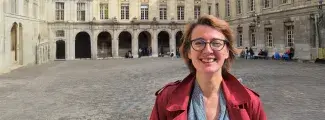
Gaëlle Tallet is confirmed as Director of the Jaussen & Savignac Archaeological Research Center
Gaëlle Tallet is confirmed as Director of the Jaussen & Savignac Archaeological Research Center at Paris 1 Panthéon-Sorbonne University: A Profile
Gaëlle Tallet, Professor of Mediterranean Archaeology and of the Hellenistic and Roman East, at Paris 1-Panthéon-Sorbonne University, has just been confirmed as Director of the Jaussen & Savignac Archaeological Research Center by Christine Neau-Leduc President of Paris 1 Panthéon-Sorbonne University, on the proposal of the Center’s Steering Committee.
Gaëlle Tallet’s research is rooted in the Near Eastern regions, and more particularly in Egypt: since 2000, she has been working with the El-Deir Archaeological Mission in the Kharga Oasis (Egypt), where she assumed its leadership in 2008. Within this framework, she has led two projects funded by The Research National Agency (ANR in French) : the international ANR collaborative project entitled « CRISIS » addressing the oasis environment from a comparative perspective, focusing on environmental crises and the responses developed by ancient societies in extreme environments, and also the Youth researchers project entitled « OASIS » focused on the 'biography' of the El-Deir micro-oasis.
In 2022 Gaëlle Tallet appointed full Professor at Paris 1 Panthéon-Sorbonne University. She thus succeeded François Villeneuve, who had contributed greatly to the development of archaeology at Hegra in Saudi Arabia. It was therefore only natural for this researcher to bring questions related to the oasis environment into her work when implementing the Jaussen & Savignac programme in March 2024, in scientific collaboration with the Royal Commission for AlUla: This project, both educational and scientific in nature, indeed focuses on six major themes: Environmental Heritage: Oasis Landscapes ; Conservation and Restoration in the Arabian Peninsula ; Archaeology 2030: Archaeology and New Technologies ; Arabian Peninsula: Cradle and melting pot of cultures and religions ; Arabian Peninsula:crossroads between the East, Africa and the Mediterranean ; Epistemology and Historiography of Archaeology and Conservation in the Eastern Regions.
Heading to the Jaussen & Savignac Archaeological Research Center, Gaëlle Tallet is particularly happy to continue scientific collaboration with Saudi researchers. She also looks forward to working on the articulation, within the framework of the Programme, between student training (Saudi, French, and international students), scientific research, and cultural mediation, particularly through the dissemination of knowledge to the populations of AlUla and, more broadly, of Arabia.
The main interest of this programme is to develop collaboratively, with our Saudi colleagues, innovative archaeology for the years to come
The Jaussen & Savignac Programme already hosts two main multidisciplinary scientific research projects – HAP and AZAP – and will contribute over the next three years to exploring major and innovative themes across the Middle East, through the hosting of PhD and postdoctoral researchers: According to Dr. Tallet, ‘The main interest of this programme is to develop collaboratively, with our Saudi colleagues, innovative archaeology for the years to come, as research and training mutually reinforce each other in various ways. Indeed, the Jaussen & Savignac Master’s programme is designed to help future Saudi, French, and international researchers navigate their cultural differences and develop the ability to collaborate effectively: In this way, we aim to strengthen collaboration within the next generation of researchers. Moreover, our training programme is designed in close connection with the activities of the Research Center: the two research projects we lead (HAP et AZAP) also provide a learning ground for these students during field schools.
More broadly, this Franco-Saudi project gives us concrete opportunities to consider what our ideal vision of archaeology might be, particularly in the Middle East, but extending beyond it as well. For instance, we have already established the foundations for preventive conservation integrated into archaeological excavation and now seek to develop preventive conservation protocols tailored to this region, moving beyond the mere application of protocols and methodologies conceived in and for the West. As part of this research, our approach begins directly in the field, taking into account its environmental context and unique characteristics’.
The Jaussen & Savignac programme The programme is still in its early stages, as the first cohort of Master’s students has just completed their first year of training last June, and it will require a great deal of energy—but ‘it’s worth it,’ Gaëlle Tallet exclaims warmly ‘for we all benefit from expanding our intellectual horizons and strengthening our scientific collaborations’.