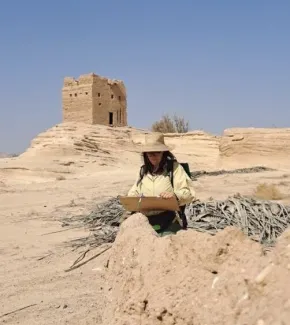
The Ethnography of HAP: When Research Becomes Dialogue
While archaeological research continues on the ancient city, the Hegra Archaeological Project (HAP)
— co-directed by Dr. Pauline Piraud-Fournet (Jaussen & Savignac Programme) and Asst. Prof. Dr. Abdullah S. Basonbol (King Saud University), and carried out by Université Paris 1 Panthéon-Sorbonne and the Agence française pour le développement d'AlUla - AFALULA, on behalf of The Royal Commission for AlUla (RCU) — also strives to understand the human occupation of the site up to the present day. This entails a systematic survey of agricultural and pastoral areas, landscape analysis, and ethnographic research.
This season, our team — composed of three architects (Dr. Mounia BOUALI, @Baltazar Cabanes, and @Jeanne Clozier), a landscape architect (Laure Piraud), a social historian and anthropologist (Dr. Géraldine Chatelard), and an archaeo-ethnobotanist (Dr. Hussein Madina) — has welcomed four research assistants from the AlUla County: Tariq Alanzei, graduate in English and with a degree in Anthropology, @Hanan Albalawi, graduate in Journalism, Abdulkarim Alanazi, graduate in Archaeology, and Taibah alanzi, graduate in English.
After a five-day training session led by Drs. Bouali, Chatelard, and Madina, the research assistants are now conducting interviews with members of the last generation who lived on the archaeological site during the 20th century and are preserving memories of past lifestyles. The project will shed light on the evolution of agricultural installations and practices around Nabataean wells, on dwellings in earthen farmhouses and tents, as well as on the use of pastoral areas.


