Exploring Iberian Peninsula art to renew the study of the rock art of the first herders of the Eastern Sahara: a true methodological challenge
Élise Melão-Pinard (Elise M.), one of thePhD students in the Jaussen & Savignac programme, is working on the rock art of the eastern Sahara, focusing particularly on the transitional period between the art of hunter-gatherers and that of the first Neolithic herders, between the 9th and 3rd millennia BCE.
To carry out her research — supervised by @Marianne Christensen (Université Paris 1 Panthéon-Sorbonne, UMR TEMPS), co-supervised by @Marcos García Diez (Universidad Complutense de Madrid), and co-mentored by Emmanuelle Honoré (Université Paris 1 Panthéon-Sorbonne, UMR TEMPS) — Élise took part in September in a field mission coordinated by @Juan Francisco Ruiz López, as part of the project “4D ARTE RUPESTRE – Investigación y preservación del arte rupestre”, on the Villar del Humo site in Spain, listed as a UNESCO World Heritage Site.
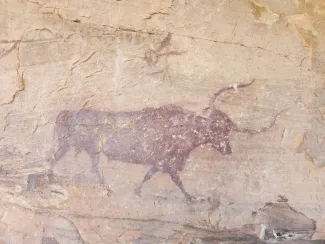
🐂The challenge for this doctoral student was to experiment with a new methodological approach, while also allowing her to discover Levantine art and schematic art — two successive pictorial traditions that provide a relevant example for her reflection on artistic and cultural transformations in the eastern Sahara.
Will the study of these scenes of daily life reveal more about this world of transhumance? Stay tuned here for more insights!
Will studying these scenes from everyday life tell us more about this world of transhumance? Stay tuned here to find out more

