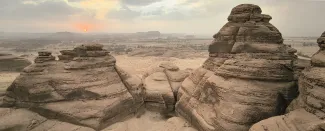
The Autumn 2026 Archaeological Campaign Continues at Hegra
From September to December 2026, the Hegra Archaeological Project (HAP) is conducting a new archaeological research campaign at the site of Hegra, in Saudi Arabia. Co-directed by Abdullah S. Basonbol and Pauline Piraud-Fournet, this campaign brings together nearly 50 researchers, technicians and student trainees, working across several research areas dedicated to the history and occupation of the ancient city.
Conducted as part of the Jaussen & Savignac Programme at Université Paris 1 Panthéon-Sorbonne, under the auspices of the Royal Commission for AlUla (RCU) and the French Agency for AlUla Development (AFALULA), this campaign brings together a multidisciplinary team carrying out surveys, landscape studies, archaeological excavations and artefact analysis.
Documenting the territory's ancient and recent occupations
The first part of the research focuses on studying remains located around the ancient city. Interviews and systematic surveys are being conducted to document traces of the territory's most recent occupation during the 20th century.
Within the vast archaeological area, the teams are also continuing to identify traces of ancient occupations associated with agricultural and pastoral activities. These observations are complemented by geoarchaeological studies aimed at better understanding the evolution of landscapes and the relationships between human societies and their environment.
Nine excavation operations across different areas of the site
Nine excavation areas have been opened in several parts of Hegra: the plain, the wadi, the ancient city, the Roman fort, urban neighbourhoods, areas outside the city walls and the necropolis.
This research aims to clarify the functions of the different sites and buildings discovered, understand their extent and evolution over time, and document more thoroughly the earliest phases of occupation at the site, dating to the Lihyanite period. The study of funerary practices is also a major focus of HAP's research.
This campaign also provides an opportunity to train several Saudi students (from King Saud University, Princess Nourah University and Durham University) and French students (from Université Paris 1) in field archaeology.
Restoring and studying archaeological artefacts
Alongside the fieldwork, the teams are continuing to study and conserve the archaeological artefacts uncovered. Ceramics, stone objects and metal artefacts are undergoing conservation and research work, essential to their interpretation and presentation to the public.
Exchanges with other archaeological missions in the region
The campaign also includes meetings and exchanges with teams from other archaeological projects operating in the region: the Islamic Khaybar Archaeological Project (IKAP), the project Toward an Understanding of Sedimentary Archives, Palaeoenvironments and Past Human Societies in Khaybar (TUPAK), and the project Dynamics of the Regional Early Holocene in Khaybar (DREH), in Khaybar; as well as the Dadan Archaeological Project (DAP) and the project Ceramic Material Culture of Ancient AlUla and Khaybar (CMCAAK), in Dadan.
These exchanges also extend to visiting academics, notably from the University of Helsinki and the École Pratique des Hautes Études.
Through this new campaign, the Hegra Archaeological Project continues its archaeological exploration of a major site on the Arabian Peninsula, bringing together different approaches and areas of expertise to deepen our understanding of its history, landscapes and successive phases of occupation.


