3D Heritage Modelling Internship
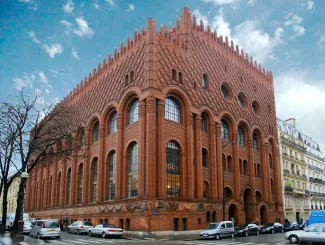
At the Institute of Art and Archaeology of Université Paris 1 Panthéon-Sorbonne, digital tools are playing an increasingly important role in the study, documentation and enhancement of heritage.
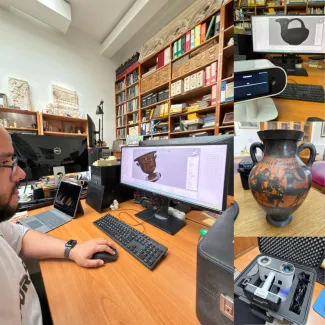
From 15 June to 3 July 2026, Saad Bin HAWTAN, a Master 1 student in Archaeology and Preventive Conservation – Jaussen & Savignac Programme (Université Paris 1 Panthéon-Sorbonne and The Royal Commission for AlUla), completed an internship within the Images and Digital Technologies Unit, under the supervision of Cyrille Galinand.
This experience introduced him to the different stages of 3D modelling applied to heritage, from data acquisition to processing, visualisation and enhancement. The internship focused in particular on photogrammetry, the use of 3D scanning, the production of digital models, and the issues involved in their publication and archiving.
Beyond learning tools and techniques, the internship enabled Saad to gain a better understanding of the role of digital data in contemporary archaeological practices. 3D modelling provides a valuable means of documenting objects and archaeological remains, preserving a digital record of discoveries, facilitating their study, and contributing to their dissemination to different audiences.
This approach directly complements the teaching provided within the Master 1 programme in Archaeology and Preventive Conservation. The curriculum includes Archaeological Computing, which explores the computer-based tools used in archaeology, from surveying to the management and publication of excavation data, with an introduction to GIS, databases, virtual reality and artificial intelligence.
It also forms part of the teaching dedicated to methods for studying archaeological objects, which includes documentation, archaeological drawing and 3D modelling.
Saad’s experience therefore illustrates the growing importance of digital skills in heritage professions. From data acquisition to preservation and transmission, 3D technologies offer new approaches to the scientific documentation and enhancement of archaeological collections.